Deep Focus or Shallow Focus.
Deep Focus is for work that needs all of you, and it runs 25 to 120 minutes and catches a chapter. Shallow Focus covers the inbox and the errands, from 10 minutes up, and pays coins without a chapter.
Pomodoro for ADHD
You have been about to start for an hour. The task is right there, and so is your phone. Last time you set a 25-minute timer, you felt worse at minute 25 than at minute zero. Catch the Ghost gives the next session something to win. Pick a ghost and a length from 25 to 120 minutes, put the phone down, and watch the next chapter from history paint itself in.
It can, once 25 minutes stops being the rule. Pomodoro gives you a start line and a finish line, which matters when starting is the hardest part of the job. Two parts get in the way: the fixed block, and the empty ending, where a bell rings and nothing happens. So focus for however long feels right today, and finish on something you want.
With ADHD, a reward that lands now pulls harder than one promised for later, and a bell at minute 25 is a thin reward. A chapter from history that opens the second you finish gives the session an ending worth reaching.
Ask what gets you started and the answers tend to repeat: something you're curious about, something new, a bet worth winning, a deadline that's real. A Deep Focus session gives you a version of each. You pick a ghost you want to know, the chapter is one you haven't read, you can stake coins on finishing, and if you quit, the chapter gets away.
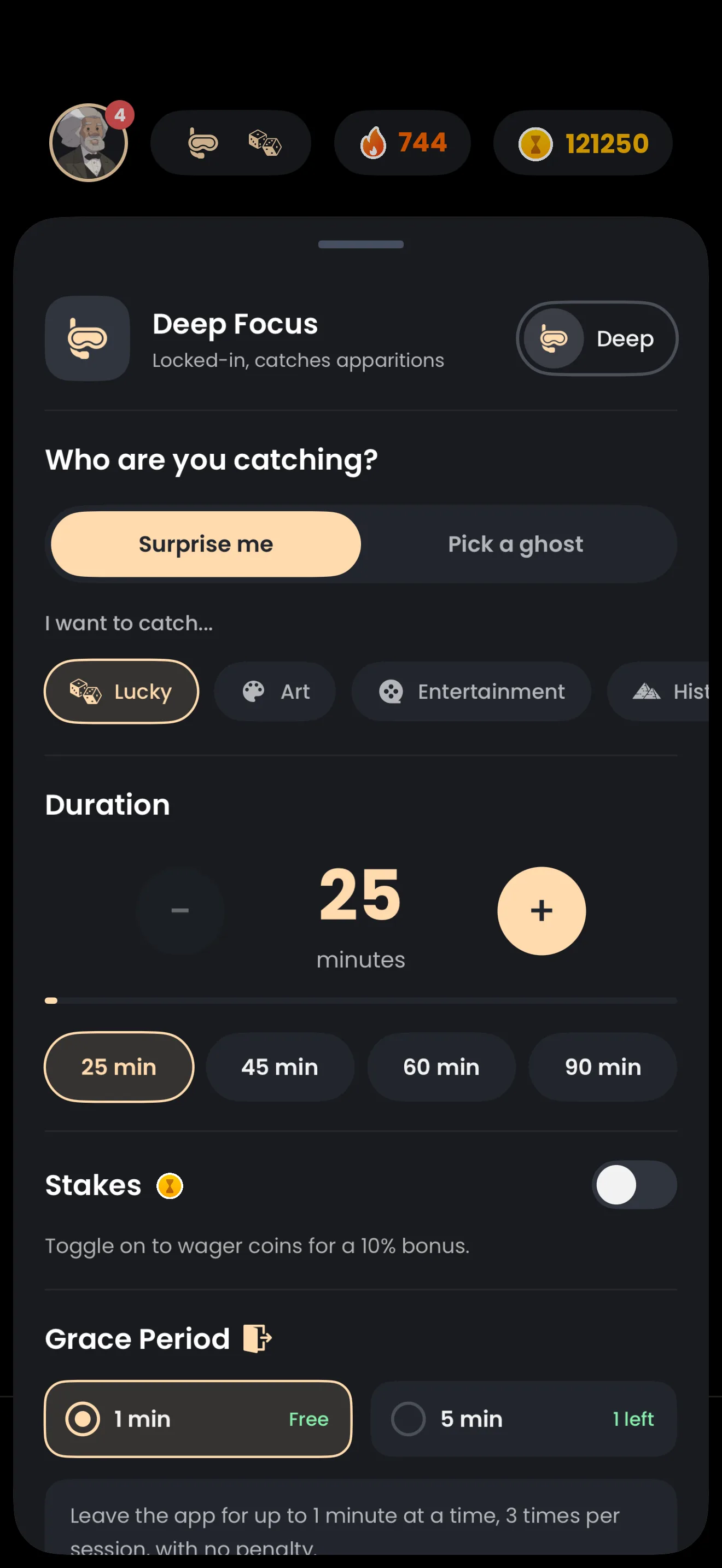
Every Deep Focus session starts with three choices: how long, who you are catching, and whether to bring company. Change any of them next time.
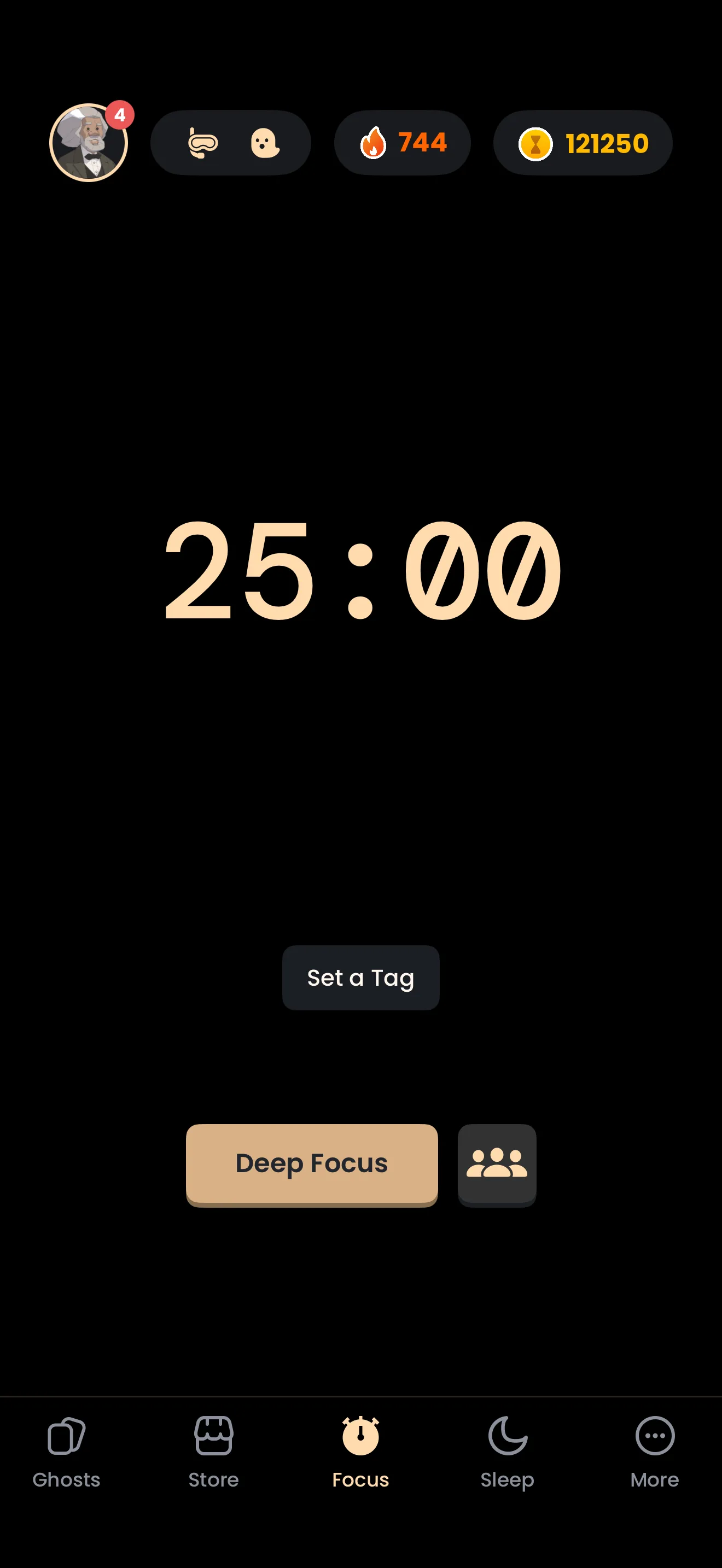
Deep Focus is for work that needs all of you, and it runs 25 to 120 minutes and catches a chapter. Shallow Focus covers the inbox and the errands, from 10 minutes up, and pays coins without a chapter.
25 minutes is the default because it's the Pomodoro everyone knows. The stepper goes to 120 in 5-minute steps, with presets at 25, 45, 60 and 90. Pick what keeps you in the chair today. Every finished Deep Focus session catches one chapter, whatever its length. The timer bends to you.
Finish and the next chapter from history opens: a quote, a story or an image, with coins and XP on top. Hyperfocus day? Run 90 or 120 minutes. Longer sessions pay more coins along the way.
Categories
Interest is most of the fuel. So before every Deep Focus session the app asks who you are catching. Pick a category, pick a ghost you're partway through, or leave it on Lucky and anyone in the library can walk out of the pixels.
Philosophy on a thinking day, Music when you need the company, Science when the work itself is technical. The other half of the picker is Pick a ghost: choose someone whose story you're already into and spend the session on their next chapter. A half-finished life is a stronger reason to start than an empty timer.
Body doubling asks nothing of your willpower: another person is there while you work, and for a lot of people with ADHD the task gets easier. Focus Together is body doubling on your phone. Someone starts a room, up to eight people join with a code, a link, or a QR scan, and every timer starts on the same second.
Finish while at least one other person finishes and you each earn double coins and double XP. If your friend steps away, nothing is taken from you. The room shows how many of you are still focusing, for example 2 of 2 focusing.
The depth model
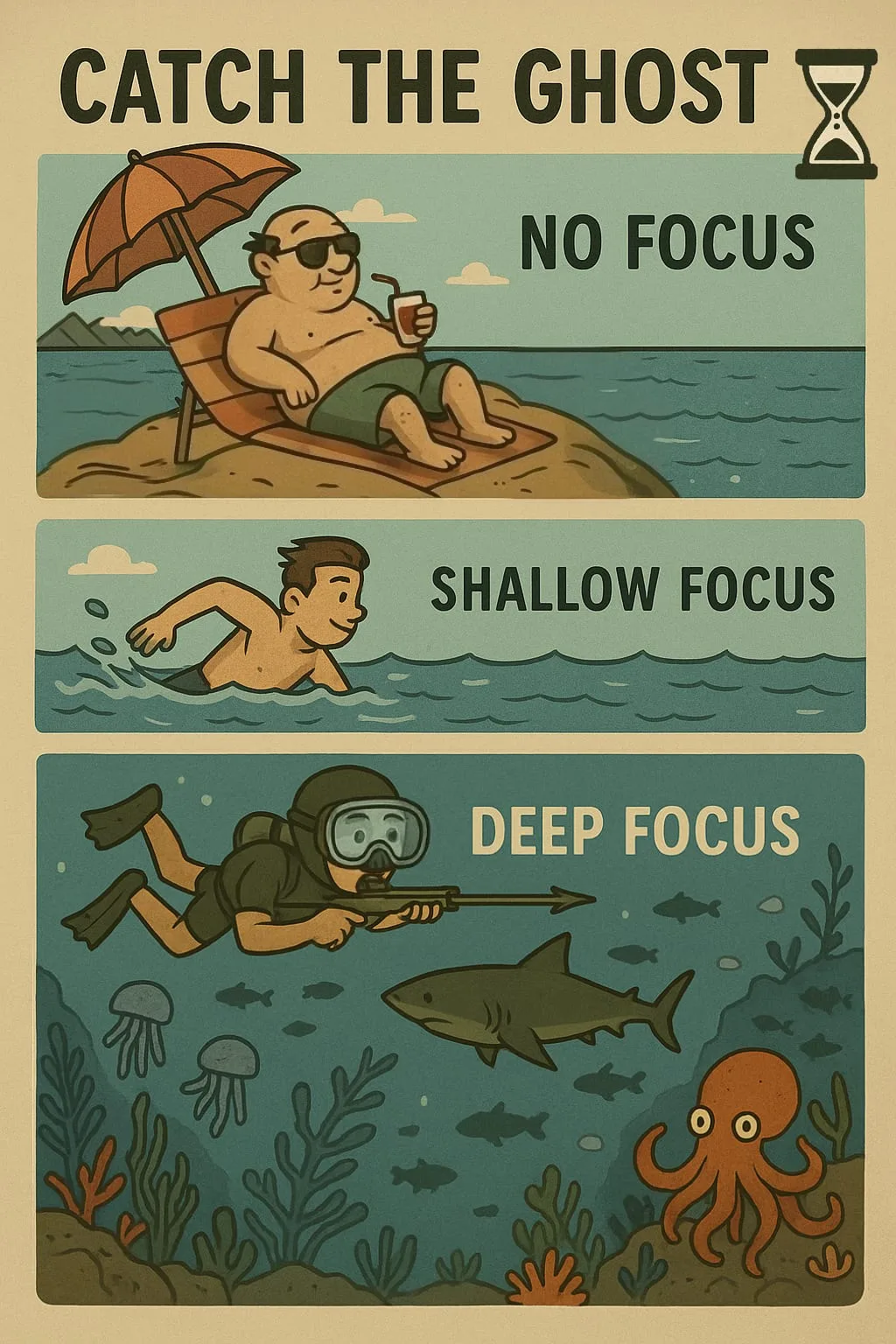
Shallow Focus is the surface swim: the inbox, errands, the kind of work you can do while the waves roll through. Deep Focus is the dive, for work that needs all of you, and it is the mode that catches a chapter. Some mornings you're on the island. Some afternoons you're diving for a shark with a spear gun. Your depth changes by the hour, so pick the mode that matches it.
Focus on consecutive days and every session pays more coins: 1.25x at 7 days, 1.75x at 30, 3x at a year. Deep, Shallow and Sleep sessions all count, so a 10-minute Shallow session keeps the streak going on a low-energy day.
Miss a day and you have two days to buy the streak back for 5,000 coins. One missed day is a lapse, not the end of the habit. Your streak lives on our servers: reinstall, switch phones, cross time zones, and earned days stay earned.
How a session plays
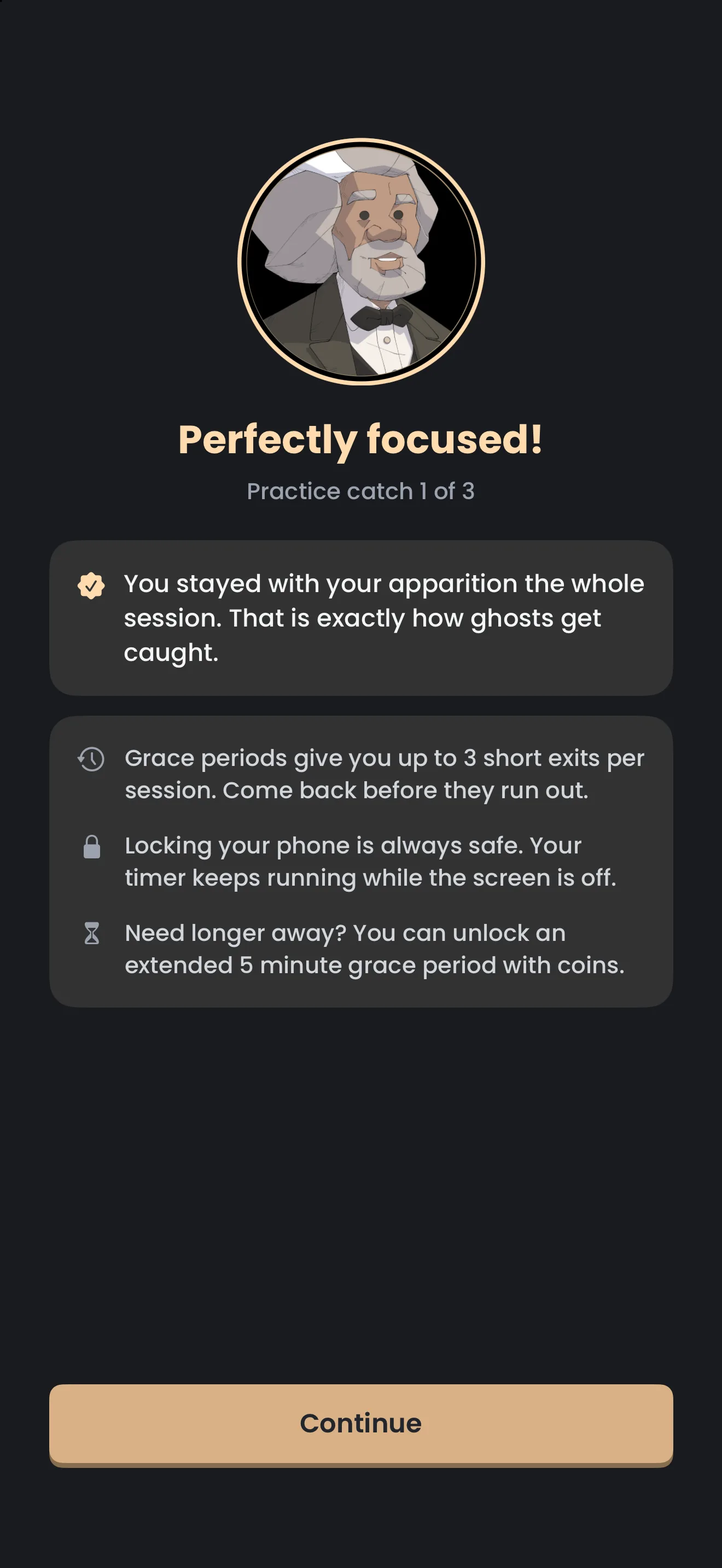
Lock your phone and that's free. Leave the app and you get three one-minute passes; stay out longer and the chapter gets away. Want more on the line? Stake up to 500 coins and get 10% on top when you finish.
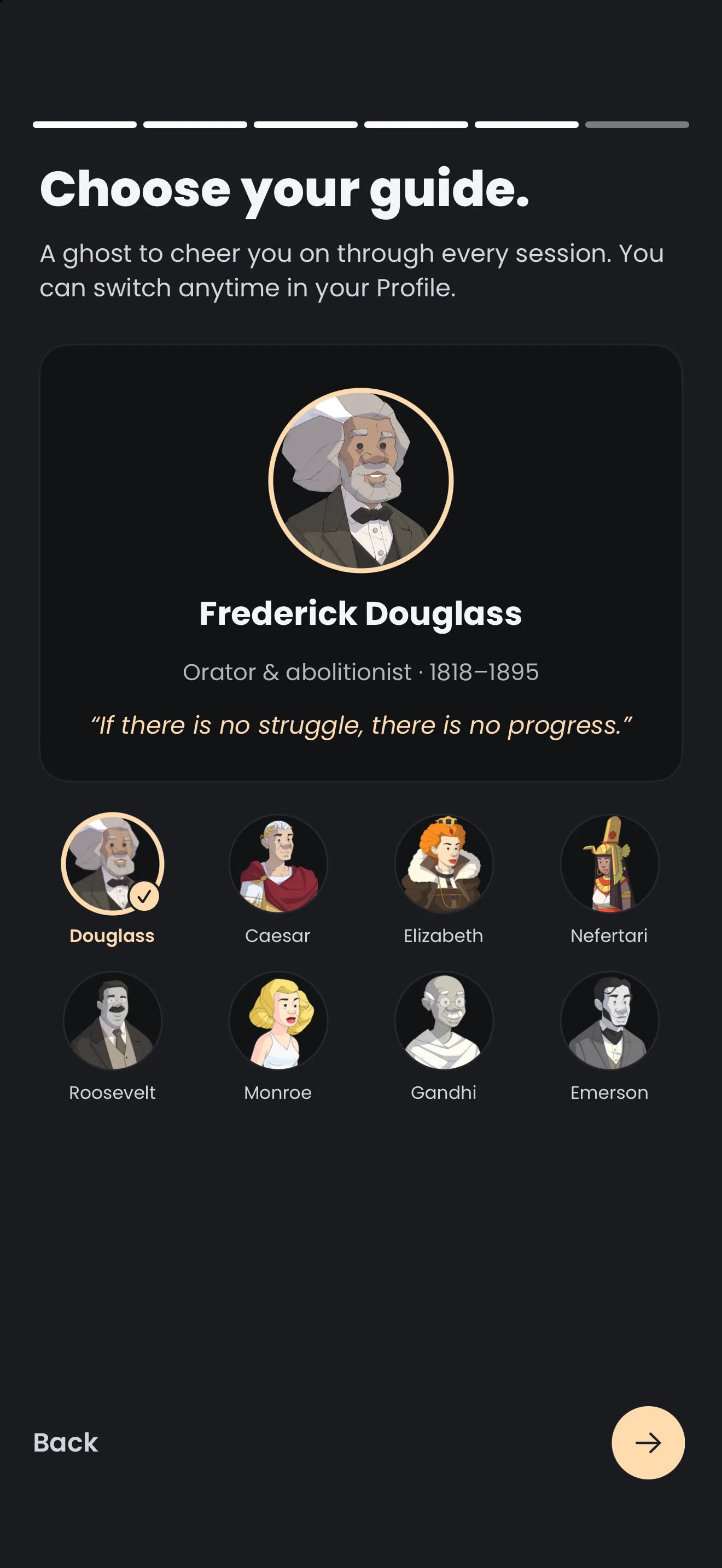
The rules don't bite until you know them. Your first three catches are practice runs: stepping away won't cost you the chapter, and only stopping the timer yourself does. A guide ghost goes through every session with you. Frederick Douglass is the default, with seven more to choose from.
Common questions
It can, once you change two things: the fixed 25-minute block and the empty ending. Pomodoro's start line and finish line help when starting is the hardest part. Pick a length that fits the day and finish on something you want. In Catch the Ghost that's a chapter from history, plus coins and XP.
Start with a length you can finish. Stay near 25 minutes on a low-energy day; when the work has you, push to 60 or 90, or all the way to 120. Deep Focus runs 25 to 120 minutes in 5-minute steps, with presets at 25, 45, 60 and 90, and Shallow Focus starts at 10. The same app handles a low-energy Monday and a deep-work Thursday.
It was designed with ADHD in mind: a length you pick every session, a category or ghost you choose, Focus Together rooms for body doubling, a reward that lands the second you finish, and a quit that costs you the chapter, not your progress. It is a focus tool, not a medical device: use it alongside treatment and whatever else works for you.
Yes, that's what it's for. Start a room, share the code, link or QR code, and up to 8 people start on the same second. Rooms run Deep Focus from 25 minutes to 2 hours. When two or more of you finish, everyone who finished earns double coins and XP.
The library is built to outlast it. There are 800+ ghosts and 7,800+ chapters, each ghost a life told in order. At one session a day the library would last you more than 20 years, and new ghosts keep arriving.
Stay out of the app too long and the chapter gets away. The ghost stays in your In Progress list for next time. Deep Focus gives you three one-minute passes per session, and locking your phone is free. Coins you have earned stay yours; only coins you chose to stake ride on the session. Your first three catches are practice: only stopping the timer yourself loses the chapter.
Miss a day and the streak resets. You have two days to buy it back for 5,000 coins. Or buy Auto Streak Recovery ahead of time, also 5,000 coins, and it restores a missed day on its own.
Free, no card. The timer, the catches and Focus Together rooms are free. Pro adds Legendary ghosts, the Sleep Timer, the Ghost Universe and Full History.